
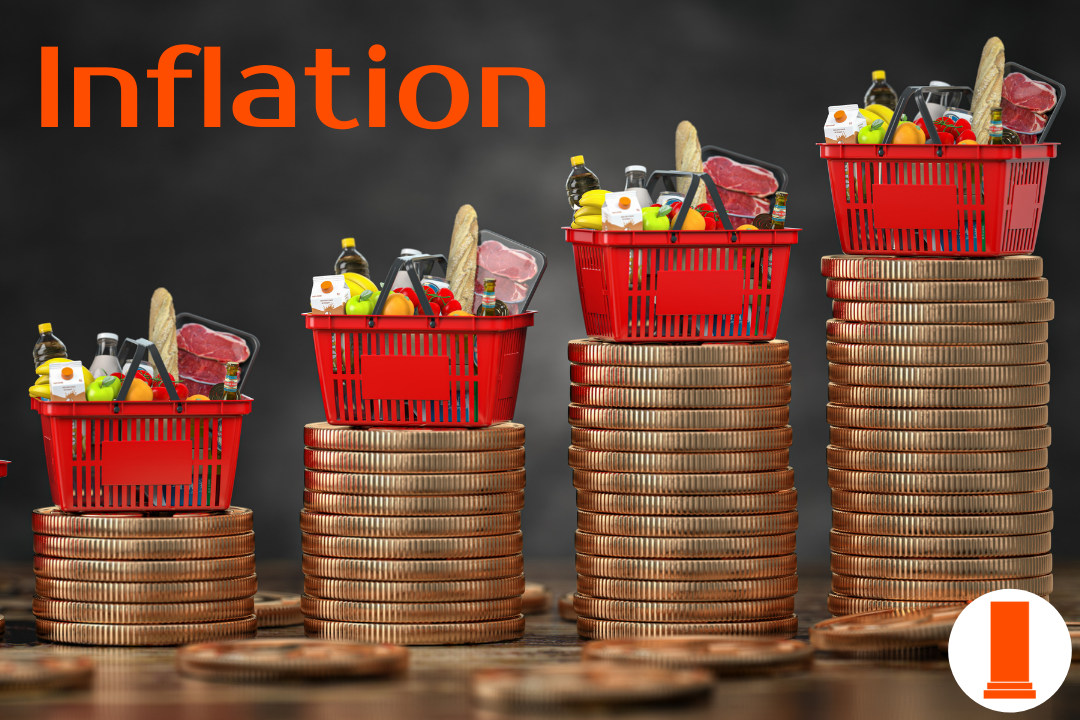
Surely you remember stories from your grandparents about how you could pay for an entire purchase of groceries with one pound back then. This is not because food was cheaper back then, but because of inflation.
In this article we would like to explain everything important about inflation and show you why it is imperative that you understand it.
Value vs. price
Basically, we first have to distinguish between two terms that are often used as synonyms for each other. One is the value and the other is the price of an object.
The value of an object increases the more benefit one can derive from it. This is why, for example, a car costs more than a bicycle. Additionally, used objects cost usually less, because one gets less benefit from a used object.
However, the price of the same object increases over time even though its value is still the same (e.g. a car in 1999 and a comparable car in 2021). In this case, the increase in price can be attributed to inflation.
The more inflation increases, the more the prices of all the things you can buy increase. This is because inflation actively lowers the value of money. For example, inflation of 2% a year means that your money is worth 2% less each year than it was the year before.
This is due to the origin of inflation. Inflation increases when money is printed, i.e. the total amount of money that exists is increased. This is based on the same principle as the value of precious metals. For example, platinum is worth more than gold because platinum is rarer. If there were now more platinum, the value of platinum would decrease. It is the same with money. More money is printed, so the value goes down.
This results in prices having to be adjusted for inflation to maintain the same value of money. This is the reason why a purchase of groceries is much more expensive today than it was 50 years ago. Fitting to this example, there is the so-called “basket of goods” statistic. Every year a new basket of goods is created that shows how much goods or services you get for your money this year compared to another year.
How much was my money worth 100 years ago?
Inflation can best be shown with a long-term example. It shows you the drastic consequences that an inflation of about 2% a year, which at first seems small, can have.
100 pounds in 1920 were worth as much as 4,570.75 pounds today. This means that British pounds have lost almost 98% of their purchasing power over this period. In contrast, the price of gold behaved quite differently.
An ounce of gold was worth $18.92 in 1914. Today, the same amount of gold costs $1769.64. This enormous price increase is of course not only due to inflation, but is definitely related to it.
The reason why gold is not affected by inflation is that there is a limited amount of gold. So, an ounce of gold is always worth the same in relative terms, because the amount of gold on earth cannot be increased. Therefore, the price of gold can increase, but the real value of an ounce of gold remains the same.
For this reason, many of the world’s currencies were also based on a so-called “gold standard”. In these cases, the value of money was linked to the price of gold. In 1971, the world’s leading currency, the US dollar, was decoupled from the price of gold and the gold standard was abolished. Since then, all currencies use so-called “fiat money”, which is not linked to any real value.
Investments as inflation protection
As you have already seen, the rise in the price of gold has more than compensated for the fall in the value of the British pound. This is because the return on an investment in gold was higher than the inflation during that period. This concept is also used today to evaluate methods of wealth accumulation.
For example, an investment that increases in value by 4% per year will more than offset inflation of about 2% per year. The real return on this example investment is in this case 4% – 2%, equals 2%. This 2% shows the real increase in value that the investment had as a result, taking into account the decrease in value caused by inflation.
You can also see from this, for example, that money in a savings account with very low interest rates of sometimes less than 1%, in real terms, reduces the value of your money over time. In this case, the real return is negative.
Therefore, we at Pillar-X protect our capital against a loss in value by investing in properties. The value of a property will only decrease in exceptional cases, but it remains stable or even increases in most years. Even if the value of a property remained the same every year, the price would still rise with inflation, so capital would be effectively protected against inflation.


 Design by